about us

One Mission, One Team

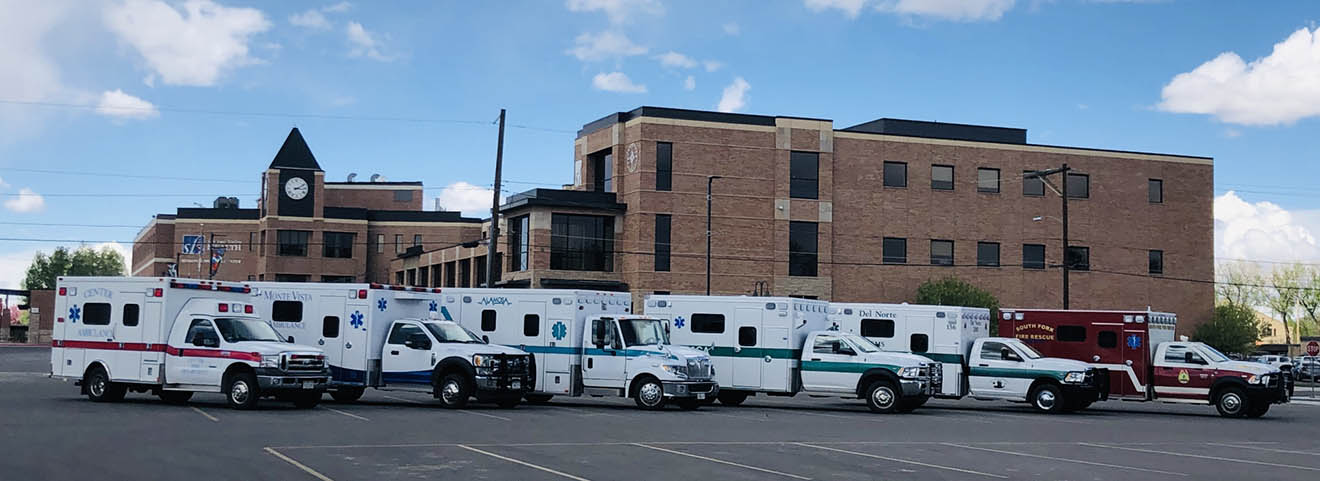
Ambulances

where we serve


Leadership


Our Bylaws


Our Policy

Our Mission

To develop, foster, and support excellence in trauma care and the emergency medical system within Colorado’s San Luis Valley.
A brief History of slv retac

The evolution of  Colorado‘s Regional Emergency Medical and Trauma Advisory Councils (RETACs) reflects the state’s transition from a fragmented emergency response system to a highly coordinated, evidence-based trauma network.
Foundational Milestones (1970s – 1990s)

1978
EMS Act

Marked the official beginning of   EMS regulation in Colorado, establishing the state’s authority over emergency services.

1989
EMS Funding Bill

Created the EMS Account within the Highway Users Tax Fund (HUTF). This provided the first stable financial foundation for providers, funded by a $1 vehicle registration surcharge.

1995
Trauma System Formation

Hospitals began voluntarily applying for Trauma Center designations. To manage this locally, Area Trauma Advisory Councils (ATACs) were established, serving as the predecessors to modern RETACs.

1997
Regional Innovation

Some regions began formalizing councils early; for example the Foothills RETAC was created in 1997 to serve Boulder and surrounding counties.

The Integration Era (2000 – 2010)

2000
Colorado EMS & Trauma Act

This landmark legislation officially replaced ATACs with the 11 Regional Emergency Medical and Trauma Advisory Councils (RETACs). It also formed the State Emergency Medical and Trauma Advisory Council (SEMTAC) to oversee the entire integrated system. Statue set funding for RETAC funding to be $75,000 and $15,000 per county

2001
EMS Funding Bill

The San Luis Valley Regional Emergency Medical and Trauma Advisory Council (SLVRETAC) began formalizing its council. 

2001
Formation of Specific Councils

Following the new act, specific regional bodies like the Northeast Colorado RETAC and Southern Colorado RETAC were officially incorporated or reorganized under the new mandate.

2010
Funding Expansion

The HUTF surcharge was increased to $2, nearly doubling available grant funding for EMS and RETAC operations to approximately $10 million statewide.

Modernization & Regulation (2016 – Present)

2016
Supplemental Support

New supplemental funding of $20,000 per RETAC was introduced to bolster regional planning and training.

2017–2020
Comprehensive Rule Updates

The Colorado Department of Public Health and Environment (CDPHE) led a multi-year review to streamline trauma system regulations, focusing on clinical best practices and clearer definitions for trauma centers.

2018–2020
Fiscal Challenges

Changes in Department of Revenue formulas for vehicle registrations led to significant funding cuts in the HUTF account, reducing available resources by over $1.6 million.

2022
Stabilization

The Colorado General Assembly supplemented the HUTF with $2 million from the general fund to offset previous losses and support rural emergency services.

2022

 While the Colorado Department of Public Health and Environment (cdphe.colorado.gov) (CDPHE) supports local EMS, the lack of this designation contributes to funding instability and threatens rural services.

Current Status and Challenges:

Not Essential: Colorado does not currently require counties to ensure EMS is provided to all residents, unlike states that have officially declared it an essential service.

Funding Gaps: Without this designation, many Colorado ambulance services rely heavily on local tax bases and patient transport, leaving roughly 40% of calls—where no transport occurs—unreimbursed.

Sustainability Crisis: A 2023 Colorado EMS Sustainability Task Force report found many local services are unsustainable, particularly in rural areas facing worker shortages and shrinking volunteerism.

Legislative Action: There are ongoing efforts, such as those planned for the 2026 legislative session, to officially designate EMS as an essential service, enable better funding for “treat-in-place” scenarios, and support alternative destination transport.

Colorado RETAC Region MAP

Colorado RETAC Region MAP
Region 1: Northeast Colorado

Region 1: Northeast Colorado

Nick Nudell

Jackson, Larimer, Logan, Morgan, Phillips, Sedgwick, Washington, Weld, and Yuma

Region 2: Foothills

Region 2: Foothills

Valorie Peaslee

Boulder, Clear Creek, Gilpin, Grand, Jefferson

Region 3: Mile High

Region 3: Mile High

Shirley Terry

Adams, Arapahoe, Broomfield, Denver, Douglas, Elbert

Region 4: Plains to Peaks

Region 4: Plains to Peaks

Kim Schallenberger

Cheyenne, El Paso, Kit Carson, Lincoln, Teller

Region 5: Central Mountains

Region 5: Central Mountains

Sarah Weatherred

Eagle, Summit, Lake, Chaffee, Pitkin, Park

Region 6: Southeastern Colorado

Region 6: Southeastern Colorado

Brandon Chambers

Crowley, Otero, Bent, Prowers, Baca, Kiowa

Region 7: Southern Colorado

Region 7: Southern Colorado

Brandon Chambers

Pueblo, Fremont, Custer, Huerfano, Las Animas

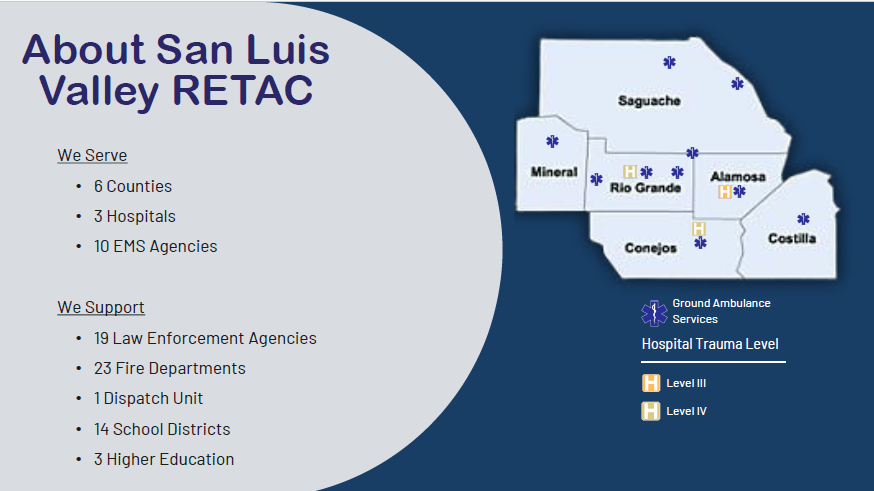
Region 8: San Luis Valley

Region 8: San Luis Valley

Reyna Martinez

Alamosa, Rio Grande, Conejos, Costilla, Mineral, Saguache

Region 9: South West

Region 9: South West

Fred Hutt

La Plata, Montezuma, Archuleta, San Juan, Dolores

Region 10: Western

Region 10: Western

Danny Barela

Mesa, Delta, Montrose, Ouray, Gunnison, San Miguel, Hinsdale

Region 11: Northwest

Region 11: Northwest

Addy Bristol

Moffat, Rio Blanco, Garfield, Routt